RecipeCast
Build a production-ready SaaS platform that fills the void left by Google Cookbook, allowing users to cast recipes from any site to their TV with reliable state management and a distraction-free cooking experience.
Client
RecipeCast is a self-founded Micro-SaaS platform designed for home cooks. It provides a modern solution for casting recipes to TVs and smart displays, offering a hands-free cooking experience that works with any recipe site.
Challenge
Home cooks faced constant frustration following the discontinuation of Google’s Cookbook app. I identified several key friction points that needed to be solved:
- Screen locks: Devices locking during cooking required constant unlocking with messy hands.
- Ad-heavy content: Finding actual recipe steps amidst ads on mobile sites was difficult.
- Hardware limitations: Small phone screens were hard to read from a distance while cooking.
- Lack of alternatives: No existing solution provided reliable casting to Google Cast-enabled devices.
Approach
I needed to architect a system that prioritized reliability and universality. The approach involved deep technical discovery into the Google Cast SDK and structured data parsing.
Authoritative Receiver Pattern
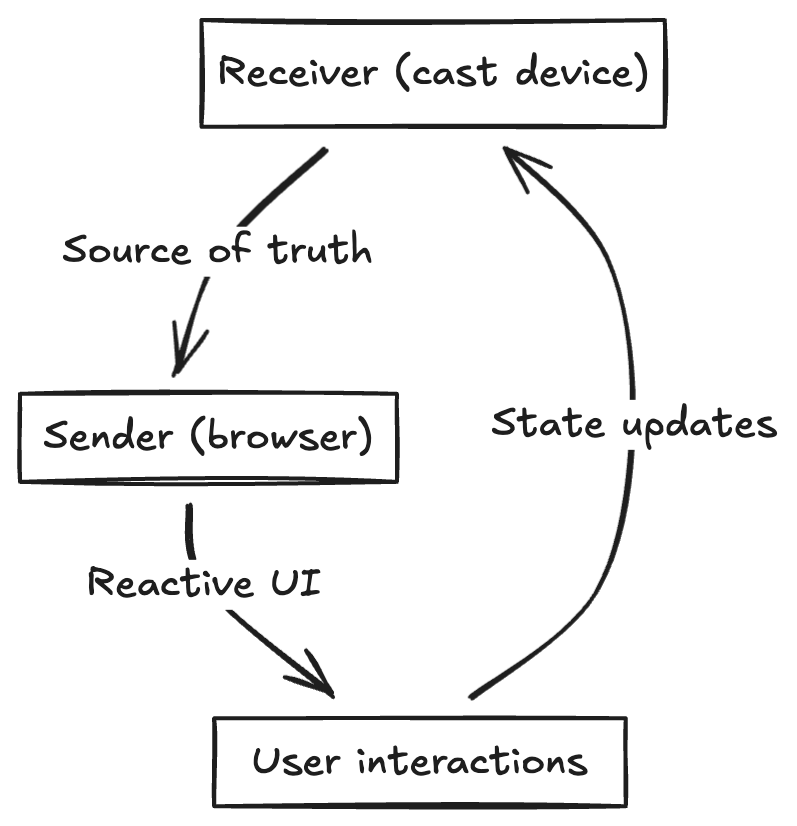
To handle the complexity of the Cast SDK, I designed an architecture where the cast receiver device controls all state to ensure synchronization.
Recipe Extraction
I built a two-tier recipe extraction pipeline: a FastAPI service (primary) and a Cloudflare Worker (fallback). The Wasp backend calls the Python API first; if it fails (timeout, 5xx, or site block), it falls back to the proxy worker. Both return normalized Schema.org-style recipe data so the rest of the app stays unchanged.
Primary: FastAPI
Stack: Python, FastAPI, deployed on Railway Features: JWT auth, per-user rate limiting, URL validation and SSRF protection, Datadog APM. Why primary: Better structure, validation, and observability; easier to extend and harden.
Fallback: Cloudflare Worker
Role: Original extraction layer; used only when the FastAPI call fails at runtime. Coverage: Handles 200+ recipe sites as a proxy that detects and extracts recipe data.
Solution
I built a production-ready SaaS platform using Wasp (React + Node.js) that integrates seamlessly with a custom Google Cast implementation.
The solution focused on two core technical achievements:
- Reliable Cast Integration: Implementing an authoritative receiver architecture to maintain synchronized state, handle network interruptions, and manage session timeouts gracefully.
- Universal Parsing: A two-tier extraction pipeline—FastAPI as the primary service, with a Cloudflare Worker as fallback when the API fails. The worker continues to support 200+ recipe sites; the Wasp backend tries the API first, then the worker.